How to Choose Low-Noise Industrial Cleaning Equipment for Malls, Hospitals, and Schools Based on Cleaning Conditions

Author: SIBEN     Publish Time: 2026-08-21      Origin: Site

Inquire

In modern urban management, shopping malls, hospitals, and schools are high-traffic public spaces that demand exceptionally high standards for cleaning efficiency, safety, and environmental quality. However, these environments are extremely sensitive to noise control—hospitals require quiet conditions for patient recovery, schools need to maintain classroom order, and shopping malls strive to provide a comfortable shopping experience for their customers.


Therefore, scientifically choosing low-noise industrial cleaning equipment (such as silent scrubber-dryers and sweepers) tailored to the specific working conditions of each venue has become a core task for property management and logistics procurement.

I. Shopping Malls: Balancing High Traffic with High Efficiency and Aesthetics

1. Working Condition Characteristics

  • Spacious layouts and complex traffic flows: Malls typically feature wide corridors, which often intersect with atriums, corners, and dense customer traffic.


  • Special time windows: To avoid disrupting business operations, cleaning is mostly conducted in the early morning before opening or late at night after closing. Some high-end malls also allow localized maintenance during off-peak daytime hours.


  • Diverse flooring materials: Mostly marble, tile, granite, etc., requiring exceptionally high standards for slip resistance and quick drying.


2. Selection Strategies and Recommendations

  • Equipment Type: Medium walk-behind or compact ride-on scrubber-dryers are the top choice. Ride-on equipment can significantly boost large-area cleaning efficiency prior to opening.


  • Noise Standards: Operating noise should ideally be controlled below 65 dB, ensuring that even during occasional daytime operations, it does not cause customer annoyance.


  • Key Features:


    • Equipped with an Eco silent mode to further reduce vacuum motor noise while maintaining cleaning performance.


    • Excellent water recovery and powerful squeegee design to ensure floors are "dry immediately after washing," preventing customer slips and falls.
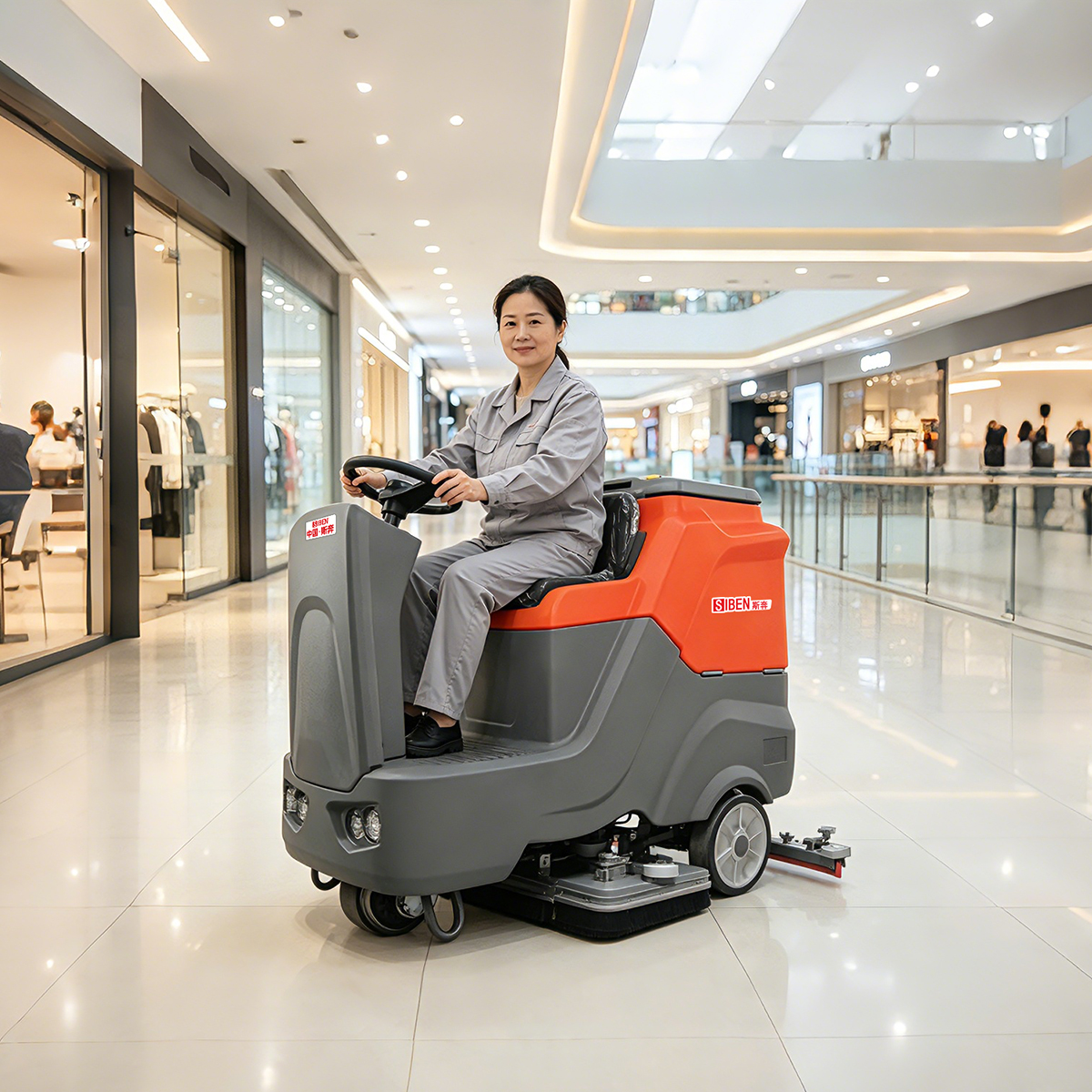
      4

      ( Shopping Mall Floor Scrubber X8 )

II. Hospitals: Strict Silence and Hygiene Standards

1. Working Condition Characteristics

  • 24/7 noise sensitivity: Wards, outpatient departments, and hallways are highly sound-sensitive areas where noise directly interferes with patient rest and doctor-patient communication.


  • High hygiene and epidemic prevention standards: Floors must not only be clean, but also disinfected thoroughly using cleaning solutions without generating secondary dust or odors.


  • Dynamic spaces: Waiting areas are crowded, while hallways and corridors are relatively narrow.


2. Selection Strategies and Recommendations

  • Equipment Type: Ultra-silent walk-behind scrubber-dryers or compact equipment with a small turning radius (chassis width ideally under 60 cm for easy passage through elevators and narrow corridors) are recommended.


  • Noise Standards: Must feature ultra-low noise levels of around 60 dB or even 56 dB (utilizing products with multiple sound-absorbing air ducts or automotive-grade noise reduction materials) to ensure operations near wards are virtually silent.


  • Key Features:


    • Solution and recovery tanks made of non-toxic, eco-friendly, and antibacterial materials.


    • Precise water flow control and multi-dimensional water distribution structures to avoid chemical residue and excessively wet floors.
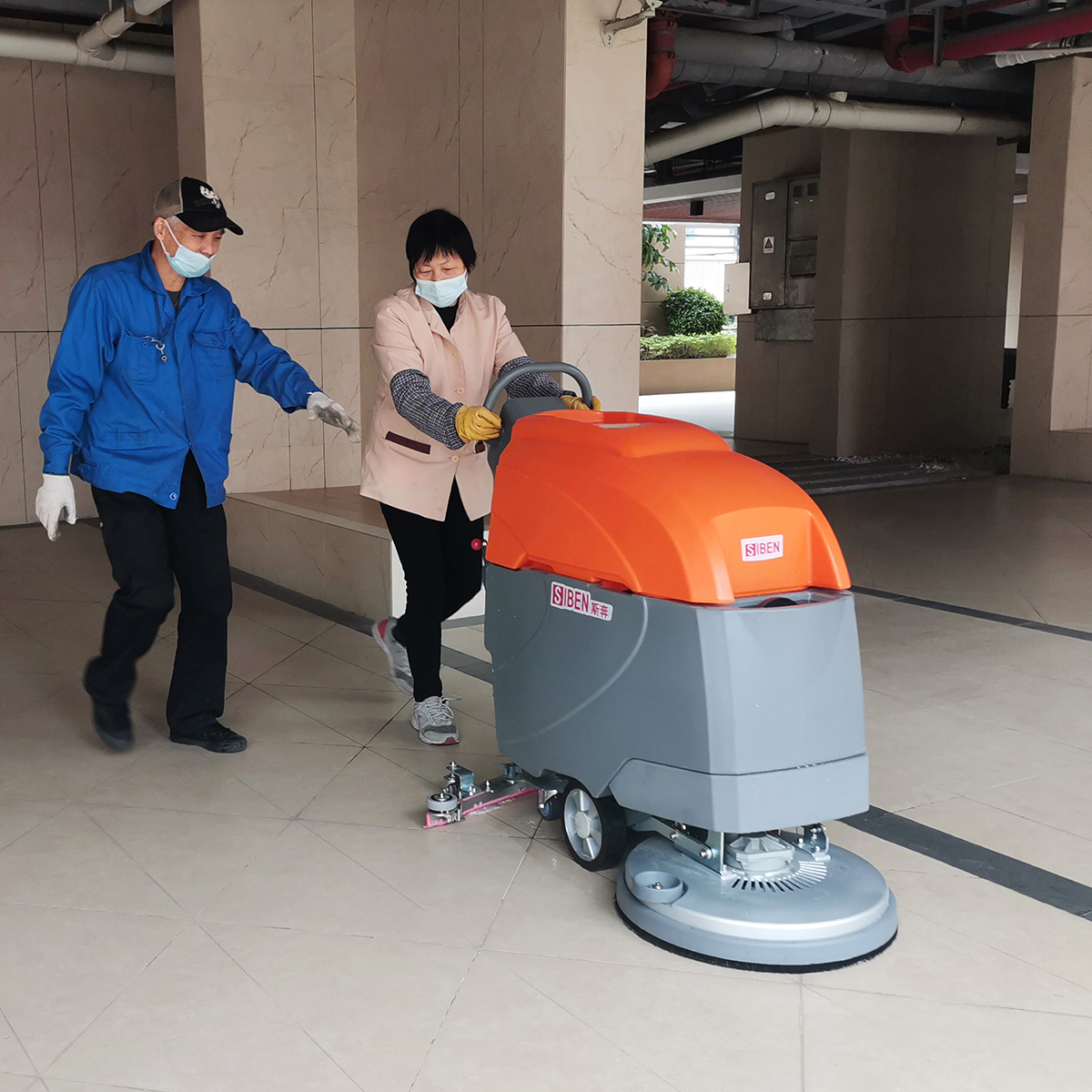
      4

      ( Hospital Floor Scrubber X5 )

III. Schools: Balancing Teaching Order and Multi-Area Adaptability

1. Working Condition Characteristics

  • Highly concentrated time periods: High decibel noise is strictly prohibited during class changes, transition periods, and study hours in teaching buildings and libraries. Meanwhile, sports fields, cafeterias, and outdoor main roads face heavy loads of fallen leaves, gravel, and other complex debris.


  • Large spatial span: Encompasses indoor corridors, classrooms (mostly PVC sports flooring or terrazzo), gymnasiums, and outdoor playgrounds.


2. Selection Strategies and Recommendations

  • Equipment Type:


    • Indoor teaching buildings/libraries: Equip with ultra-silent walk-behind scrubber-dryers or silent wet/dry vacuum cleaners.


    • Outdoor playgrounds/main roads: Choose medium-to-large ride-on sweepers to balance efficiency with dust control.


  • Noise Standards: Indoor cleaning equipment noise should be controlled around 60 dB, ensuring machinery cannot be heard from nearby classrooms.


  • Key Features:


    • Easy operation and high safety standards (featuring anti-crush and emergency stop protections).


    • Brush pressure adjustment functions for PVC plastic flooring or epoxy resin surfaces to prevent floor damage.
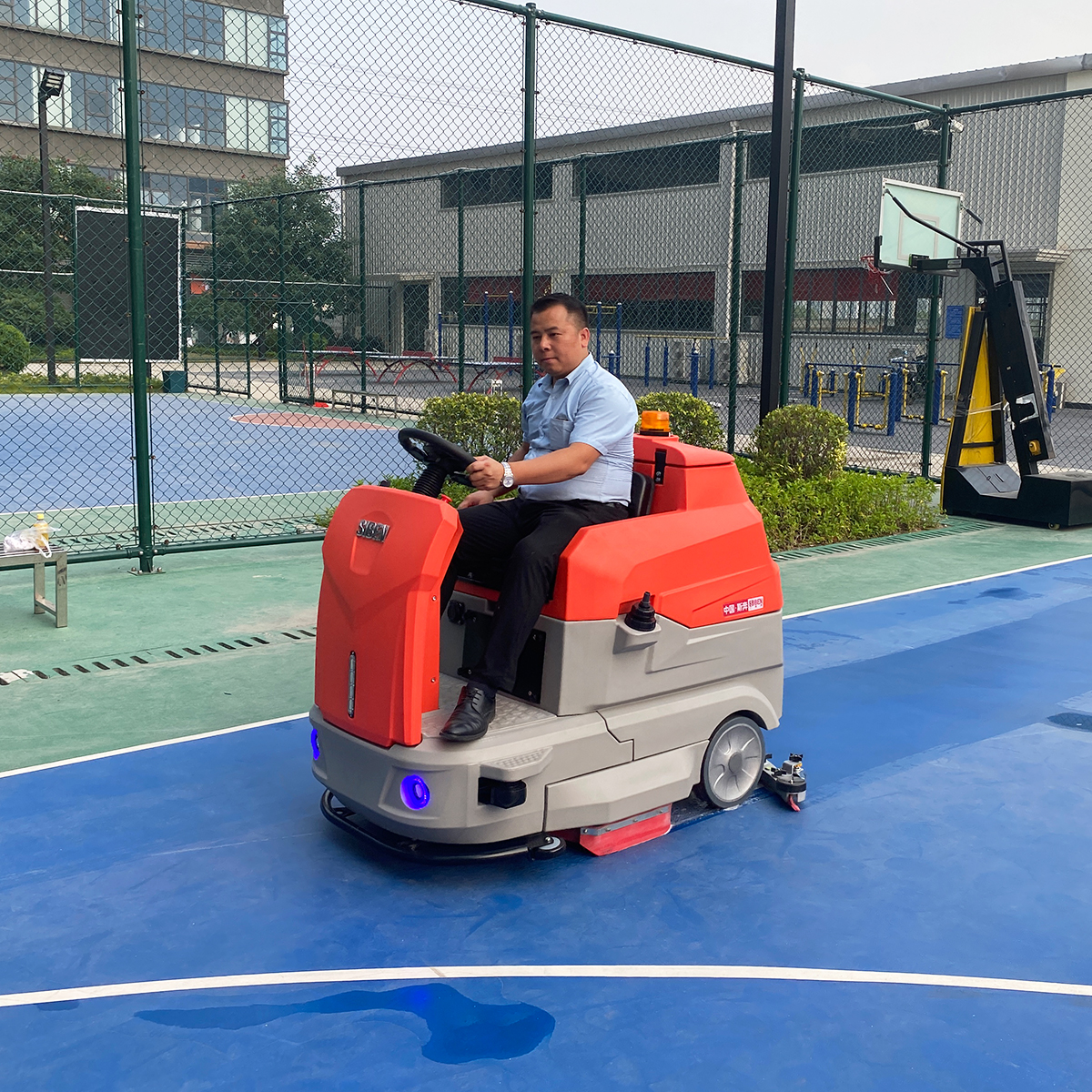
      2

      ( School Floor Scrubber Erlang Shen )
Summary: Core Selection Comparison Table

Venue Core Working Condition Pain Points Recommended Equipment Form Noise Control Threshold Key Focus Areas
Malls Efficiency priority, marble slip resistance Walk-behind / Compact ride-on scrubbers $< 65\text{dB}$ Quick drying, no water flinging on turns
Hospitals 24/7 sound sensitivity, epidemic prevention Ultra-silent walk-behind scrubbers $\le 60\text{dB}$ Extreme silence, antibacterial materials, narrow passage clearance
Schools Interclass silence, indoor/outdoor versatility Silent scrubbers + Outdoor sweepers $\le 60\text{dB}$ Simple operation, adaptability to multi-material floors
When procuring low-noise cleaning equipment for malls, hospitals, and schools, avoid a "one-size-fits-all" approach based solely on price or single parameters. Only by deeply analyzing the noise thresholds, corridor widths, flooring materials, and operational time windows of specific working conditions can you select a high-performance cleaning solution that truly fits.

What types of flooring noise or cleaning challenges is your institution currently facing in equipment selection?


NEWS
Warehouse & Workshop Dust Cleaning Compliance Guide: Eight Steps from System to Documentation
2026 / - 10 / - 09

This article outlines the compliance pathway for dust cleaning and management in industrial and trade enterprises, structured across eight key phases: cleaning systems and protocols (assigning responsibilities, target areas, frequency, and record-keeping), frequency and shift scheduling (zoned according to dust generation intensity), blind spots and high-level dust accumulation checklists, cleaning tool configuration (replacing compressed air purging with industrial vacuum cleaners and implementing wet floor scrubbing), secondary dust control and waste transfer, auxiliary inspection of dust removal systems, five categories of record-keeping logs, and compliance self-inspection checklists. Verified parameters of SIBEN's XC-series industrial vacuum cleaners and X-series floor scrubbers are integrated for equipment selection reference.

Lithium Battery Factory Floor Cleaning Solutions: Siben Industrial Sweepers & Scrubbers for Clean, Safe EV Production
2026 / - 09 / - 30

This article explains the unique floor-cleaning challenges of lithium battery production — conductive powder hazards, epoxy coating protection, and moisture/electrolyte control — and shows how a two-stage "sweep then scrub" workflow solves them. It details the Siben A300 (5580㎡/h), A600 (9500㎡/h) and A900 lithium-ion sweeper (16000-22000㎡/h, 5-6 hour runtime) together with X-series scrubbers, and provides selection guidance and an FAQ for facility and EHS managers.

How to Choose Cleaning Equipment for Auto Repair Workshops & 4S Stores: Start with 4 Contaminant Types & 5 Functional Zones
2026 / - 10 / - 06

This article proposes a "classify first, then zone" equipment selection framework for complex cleaning scenarios in auto repair workshops and 4S service centers. It first identifies four contaminant types (oil, dust, paint, mud) and their corresponding cleaning strategies, then provides equipment configuration recommendations for five functional zones — service bays & lifts, body & sanding stations, paint mixing & spray booths, car wash area, and customer reception & showroom. It also covers wet/dry separation principles, electrical & charging safety boundaries, consumables record-keeping, and six quantifiable procurement acceptance criteria, helping readers build a compliant, efficient and practical workshop cleaning system from scratch.

How to Procure and Inspect Industrial Cleaning Equipment: 6 Stages from Requirements to Final Acceptance
2026 / - 10 / - 07

This article treats industrial cleaning equipment procurement as a "mini-project," systematically breaking down six stages: requirements writing, technical parameter classification, supplier evaluation, three-level acceptance, hard contract clauses, and compliance documentation. The core approach is to translate "what to buy" into "what problem to solve," distinguish verifiable parameters from reference-only claims, evaluate suppliers through a scoring system, implement factory/delivery/final acceptance stages, and secure the deal with four contract clauses: payment tied to acceptance, warranty response, spare parts supply, and training. The article concludes with 10 FAQ and actionable checklists.

Commercial Cleaning Robot Deployment and Maintenance: A 7-Stage Guide from Site Conditions to Maintenance Ledger
2026 / - 10 / - 08

This article systematically breaks down seven stages of commercial cleaning robot deployment and long-term operation: confirming floor/traffic/network/management conditions before deployment; managing maps as versioned assets; defining physical, human-robot, and emergency safety boundaries; replacing consumables on cycle rather than on feel with proper battery management; grading faults into three levels with human-robot handoff rules; planning task allocation and resource queuing for multi-robot scenarios; and using six ledger types and four dashboard metrics for auditable maintenance management. The core thesis is that a cleaning robot is not a "black box" that runs itself once plugged in — long-term stable operation depends on whether deployment conditions are met, whether maps keep up with site changes, whether consumables are replaced on schedule, and how humans and machines hand off during faults. Includes 10 FAQ and a remote support CTA.

Industrial Cleaning Equipment Noise Control Technology: The Engineering Behind 60dB Quiet Cleaning
2026 / - 09 / - 29

This article breaks down the four core noise control technologies that enable Siben's industrial sweepers to achieve 60 dB(A) operation — equivalent to normal conversation. Through detailed engineering analysis of motor vibration isolation, brush system acoustics, airflow and filtration design, and chassis sound insulation, it explains how the A300 (2000W, 320kg) and A600 (3780W, 590kg) maintain identical 60dB noise levels despite vastly different power outputs. Real-world deployment cases in noise-sensitive environments like schools and commercial spaces demonstrate the practical value of low-noise industrial cleaning equipment.

Siben Manufacturing Craftsmanship: The Quality Assurance System Behind Industrial Cleaning Equipment
2026 / - 09 / - 28

This article reveals how Siben manufactures industrial cleaning equipment through rigorous engineering standards, an 8-stage quality control pipeline, and a comprehensive after-sales service network. It covers the Thunder God AMR autonomous cleaning robot, A-Series ride-on sweepers (A300/A600/A900), and X-Series floor scrubbers, helping procurement decision-makers understand why manufacturing quality directly impacts equipment lifespan, total cost of ownership, and cleaning performance.

Industrial Sweeper vs. Floor Scrubber: Which Machine Does Your Facility Actually Need?
2026 / - 09 / - 24

This article addresses the most common questions from factory purchasers regarding the choice between industrial sweepers and floor scrubbers. It covers the cleaning principles (dry sweeping vs. wet scrubbing), suitable application scenarios, a comparison of the specifications for the S-Pen A series sweepers (A300/A600/A900) and the X series floor scrubbers (X1-X8), and six frequently asked questions, along with a three-step decision-making process, to help users select the appropriate equipment based on the type of soil, cleaning requirements, and area size.