
Language


T: 400-880-1813
E: sibenclean@gmail.com
E: sibenclean@gmail.com
Building A2, Ping An Technology Silicon Valley, No. 76 Chuangyu Road, Zengcheng High tech Development Zone, Guangzhou, Guangdong

Author: Siben Publish Time: 2025-12-25 Origin: Site
Choosing an industrial floor scrubber feels like opening a "blind box"? Can't tell disc brushes, cleaning pads, and pad drivers apart? Pick one too small and efficiency drags you down; pick one too hard and it scratches your floors? Even worse—no spare parts supply or repair service later?
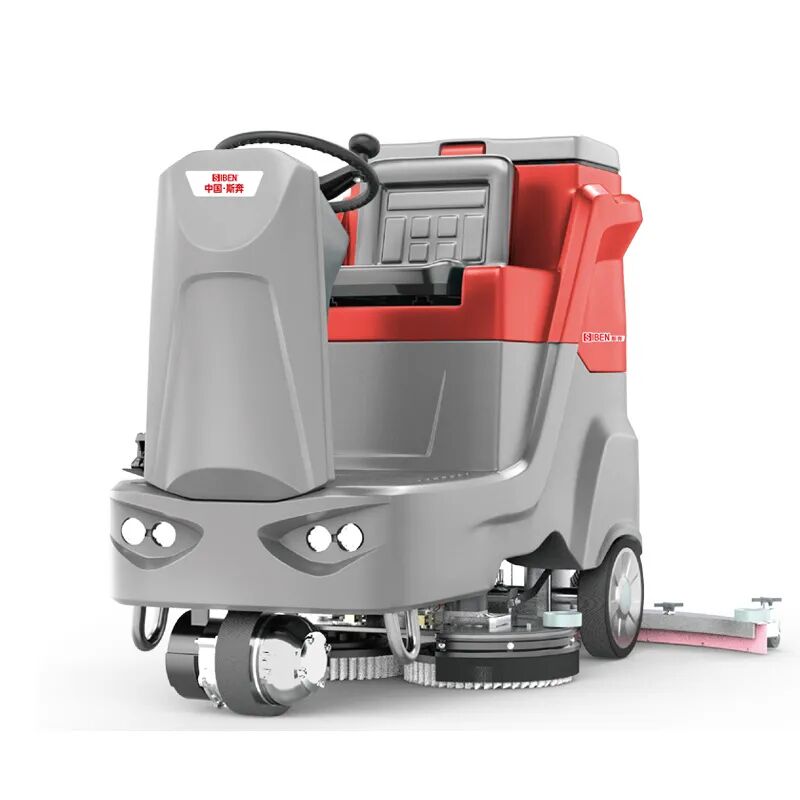
Actually, procurement boils down to one principle: "Disc Brush as Primary + Accessories as Secondary"! Cleaning pads + pad drivers are the "golden duo" for fine cleaning. Today, we'll break complex parameters into "plain English," focusing on precise matching of disc brushes + cleaning pads/pad drivers. We'll dissect 5 core selection points + a 3-step implementation process based on real scenarios—so even beginners can accurately match needs, save costs, boost efficiency, and avoid pitfalls.
Parameter 1: Cleaning Efficiency
Key Formula:
Minimum Efficiency = Workshop Available Area (excluding equipment/racks) ÷ Daily Cleaning Time
Examples:
- 1,000㎡ workshop, 1-hour daily cleaning → Choose ≥1,000㎡/h (walk-behind)
- 5,000㎡ workshop, 2-hour daily cleaning → Choose ≥2,500㎡/h (ride-on dual disc)
Dual disc brushes are 30%+ faster than single. Disc brushes ≥500mm are more efficient.
Parameter 2: Battery Runtime
Lithium Battery:
Adequate runtime (rated capacity × 1.2), 3-5 hour charging, lasts 3-5 years. Ideal for ≥2 hours daily cleaning.
Lead-acid Battery:
Downgraded runtime (rated capacity × 0.8), 8-12 hour charging, lasts 1-2 years. Only for ≤1 hour daily cleaning.
Selection Rule: Prioritize lithium batteries! Leave runtime redundancy (daily cleaning area × 1.2). Verify battery brand and warranty.
Parameter 3: Disc Brush + Cleaning Pad + Pad Driver
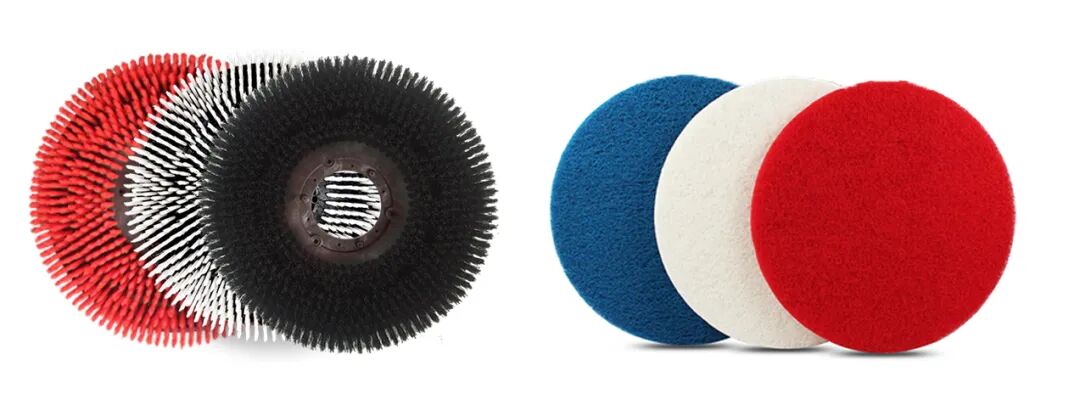
1. How to Choose Disc Brushes (Main Cleaning Power)
- Epoxy/tile floors: Soft nylon brush (30-40°), scratch-free, for dust/light oil.
- Concrete/rough floors: Hard nylon brush (60-70°), wear-resistant, for stubborn stains/concrete laitance.
- Heavy oil workshops (auto repair/machinery): Steel-wire mixed brush, removes thick grease. Pair with high-power ride-on scrubber
- Food plants/scratch-prone floors: Foam brush, flexible cleaning. Choose walk-behind model.
2. How to Choose Cleaning Pads + Pad Drivers (Fine Cleaning/Polishing)
- Daily light cleaning (epoxy/tile): Plastic pad driver (snap-on) + red cleaning pad (40-50°)—replace every 1-3 months.
- Stubborn stain pretreatment (concrete/rough): Metal pad driver (screw-on) + black cleaning pad (60-70°)—replace every 3-6 months.
- Floor polishing (showrooms/cleanrooms): Soft pad driver (snap-on) + white/blue cleaning pad—replace every 2-4 months.
3. Quick Tips
- Disc brushes ≥500mm; choose dual disc for >2,000㎡; go single disc for aisles <1.2m wide.
- Pad driver diameter must match disc brush.
- Never use black pads on epoxy/tile floors.
Parameter 4: Water Recovery System
- Squeegee width ≥ total disc brush width.
- Vacuum pump power ≥500W (dual disc: ≥600W).
- Recovery tank capacity ≥ solution tank (dual disc: ≥80L).
- Choose wear-resistant rubber squeegee, preferably **tool-free removal.
Parameter 5: After-Sales Support
- Warranty commitments.
- Spare parts availability in stock.
- 24-hour response time.
3-Step Selection Process for Beginners (Follow Directly)
Step 1: Calculate Needs
Measure available area → Determine cleaning time → Calculate minimum efficiency → Lock model type (walk-behind vs. ride-on).
Step 2: Define Combination
Select disc brush based on floor + stains → Choose cleaning pad + pad driver based on needs → Specify disc count + battery + recovery system.
Step 3: Verify Support
Confirm warranty → Check after-sales service → Verify parts supply.
NEWS
This article presents four verified customer case studies of Siben industrial cleaning equipment across hardware manufacturing, logistics warehousing, food processing, and industrial sweeping applications. Each case includes facility specifications, equipment deployed, operational results, and a structured ROI analysis covering labor savings, productivity gains, and payback periods. The Thunder God AMR cleaning robot achieved 2,750 m²/h autonomous cleaning with zero operator intervention; the X8 ride-on scrubber replaced 4 manual cleaning positions in a logistics hub; the X7 scrubber improved food safety compliance scores by 35%; and the A900 sweeper reduced dust-related complaints by 80% in a distribution center. Overall ROI ranges from 8 to 20 months depending on equipment type and facility size.
This comprehensive troubleshooting guide walks facility maintenance teams through diagnosing and resolving the 12 most common industrial floor scrubber problems. From brush and squeegee issues to battery failures, error codes, and unusual noises, each problem includes a step-by-step diagnostic flow and practical DIY fix recommendations, plus guidance on when to call for professional service.
This technical guide compares lithium-ion and lead-acid battery chemistry for industrial cleaning equipment, then explains how each technology maps to AMR cleaning robots, ride-on scrubbers and industrial sweepers in the Siben product line — helping buyers choose the right power solution with confidence.
This comprehensive guide provides expert answers to the most frequently asked questions regarding industrial floor scrubbers. From selecting the right equipment for different environments like food plants and workshops to understanding maintenance, warranty policies, and SIBEN’s manufacturing advantages, this article serves as an essential resource for professional buyers and facility managers.
This FAQ article addresses nine frequently asked questions regarding the practical application of industrial sweepers, covering cleaning efficiency, maneuverability on complex surfaces, durability testing, and return on investment. Through a comparative analysis, we reveal why industrial-grade automated cleaning equipment is the essential choice for hardware processing and manufacturing enterprises looking to cut costs and boost efficiency.
Are you concerned about the investment versus the real-world performance of transitioning to unmanned cleaning? Combining over a decade of industry expertise, SIBEN industrial cleaning robots utilize multi-sensor fusion technology and efficient autonomous operation to solve large-scale, complex cleaning challenges in industrial plants. This FAQ covers ten critical questions, from technical performance to long-term return on investment. SIBEN is committed to being your reliable partner for intelligent, life-long cleaning maintenance.
Effective floor maintenance is crucial for operational efficiency and cost control. This guide provides professional answers to the top 10 frequently asked questions regarding industrial floor sweepers. From troubleshooting common mechanical faults and battery care to comparing ride-on and walk-behind models for specific facility needs, this resource helps businesses optimize their cleaning routine, reduce labor costs, and select the right SIBEN equipment for their environment.
This FAQ guide provides in-depth answers to the most common concerns regarding industrial vacuum cleaners, from performance stability and filtration efficiency to long-term maintenance. Whether you are managing heavy metal shavings or requiring specialized explosion-proof solutions, SIBEN provides the expert insights you need to make informed, cost-effective equipment investments for your facility.

| | Address: Building A2, Ping An Technology Silicon Valley, No. 76 Chuangyu Road, Zengcheng High tech Development Zone, Guangzhou, Guangdong |
| | Custom Support & Sale: 400-880-1813 |
| | Working Time: 24 hours |
| | E-mail: sibenclean@gmail.com |
