
Language


T: 400-880-1813
E: sibenclean@gmail.com
E: sibenclean@gmail.com
Building A2, Ping An Technology Silicon Valley, No. 76 Chuangyu Road, Zengcheng High tech Development Zone, Guangzhou, Guangdong
Views: 8 Author: SIBEN Publish Time: 2026-03-02 Origin: Site


Maintaining a clean and safe floor is more than just aesthetics; it’s about operational efficiency, safety, and protecting your long-term infrastructure investment. Whether you are managing a busy warehouse, a manufacturing plant, or a commercial logistics center, selecting the right industrial floor scrubber is a critical decision.
In this guide, we will walk you through the essential factors to consider so you can choose the best industrial scrubber for your warehouse or facility in 2026.
Before looking at brands, look at your floor. The "best" machine is the one that matches your specific environment.
Floor Type: Are you cleaning smooth epoxy, rough concrete, or tiled surfaces? Rougher surfaces require higher brush pressure and durable squeegee blades.
Debris Level: Is your floor covered in heavy oil, fine dust, or large debris? If you have loose debris, you may need a sweeper-scrubber combo rather than a standard floor scrubber.
Space Constraints: Measure your narrowest aisles and doorways. Choosing a machine that is too wide will cost you valuable time during the cleaning process.
The choice between a manual vs. ride-on floor scrubber comes down to square footage and operator fatigue.
Walk-behind (Manual) Scrubbers: Ideal for smaller areas (under 1,500 square meters), congested spaces, or areas with many turns. They are more cost-effective and easier to store.
Ride-on Scrubbers: If your facility exceeds 2,000 square meters, a ride-on model is essential. It significantly reduces operator fatigue, increases productivity, and covers more ground per hour.

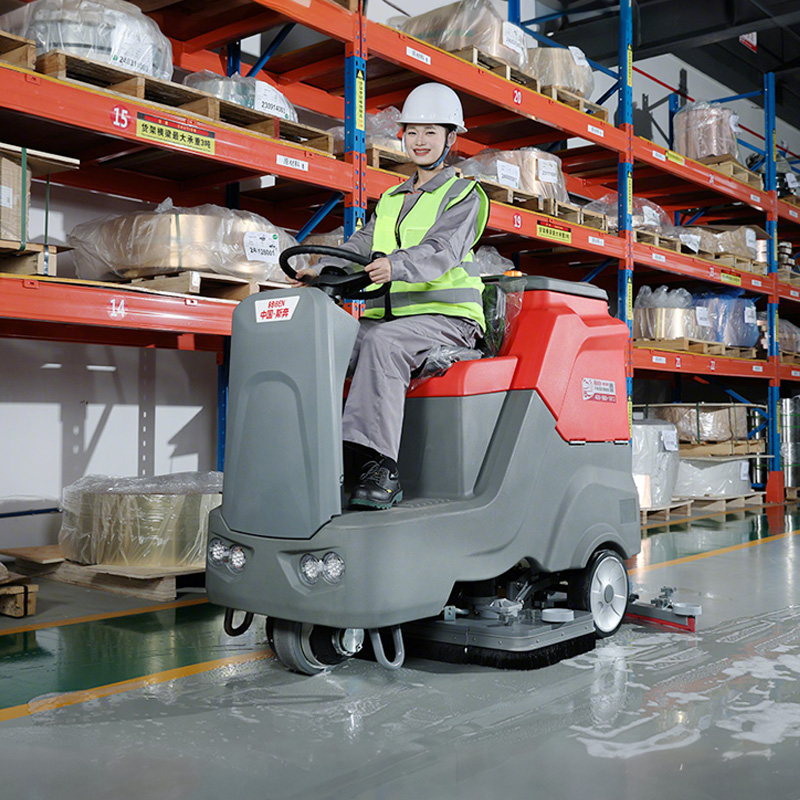
Don't just look at the price tag. Focus on these technical pillars:
Cleaning Width: A wider path means fewer passes, but make sure it still fits your aisles.
Tank Capacity: Larger tanks mean fewer stops to refill water and empty waste, which is vital for large-scale operations.
Battery Runtime: Check the battery capacity to ensure the machine can complete a full shift without needing a recharge.
When researching the industrial floor scrubber price, look beyond the initial purchase cost. Consider:
Consumables: How expensive and available are the squeegee blades, brushes, and filters?
Durability: An industrial-grade machine should be built with high-quality components to withstand daily wear.
Maintenance: Easy access to internal parts is key. Following basic floor scrubber maintenance tips—such as cleaning the recovery tank daily and checking the squeegee—will extend the life of your equipment by years.
Choosing the right cleaning equipment isn't just a purchase; it's a productivity upgrade for your facility. If you are still unsure which model suits your specific floor type and cleaning requirements, don't guess—get expert advice.
NEWS
This article explores the unique floor cleaning challenges in food processing facilities, covering HACCP/GMP compliance requirements, cross-contamination risks, and smart equipment solutions including AMR cleaning robots, industrial floor scrubbers, and sweepers. It provides practical guidance for facility managers on selecting and implementing the right cleaning systems.
This article provides a comprehensive deep analysis of Siben's X-series floor scrubber lineup, examining each model's specifications, core technologies (water management, adaptive brush pressure, vacuum recovery), application scenarios, and total cost of ownership to help facility managers make informed purchasing decisions.
Founded in 2019 and operating out of a 30,000㎡ manufacturing base, Siben is a trusted global provider of industrial cleaning equipment serving over 2,000 enterprises across 20+ countries. This article outlines Siben's corporate history from a small workshop to industry leadership, details its comprehensive five-product-line portfolio (Thunder God AMR robots, X-series scrubbers, A-series sweepers, industrial vacuums, and Red Boy compact cleaners), highlights its three core advantages in engineering, quality verification, and support, and explores how its solutions cater to manufacturing, logistics, retail, healthcare, and public sectors.
This comprehensive buying guide helps procurement managers and facility directors avoid 12 common pitfalls when purchasing industrial cleaning equipment. It covers equipment type selection (sweeper vs scrubber vs AMR robot), area-to-equipment matching with benchmark tables, realistic ROI modeling (showing 5–7 month payback for AMR robots replacing 3 workers), battery chemistry economics (lithium pays back in 12–18 months for multi-shift operations), hidden cost budgeting (brushes, squeegees, detergents, maintenance), lease-vs-buy decision rules, cleaning quality verification methods, required safety certifications (CE, ISO 3691-4, IP ratings), floor type compatibility charts, after-sales support criteria, AMR facility layout suitability checklist, and a full 5-year TCO comparison showing 42,000netcostforAMRvs218,000 for manual labor. Designed for B2B buyers in warehousing, logistics, manufacturing, and food processing.
A scrubber-sweeper combo machine integrates sweeping and scrubbing functions into one unit, while a conventional floor scrubber only washes and dries. This article explains the four key differences (workflow, application, efficiency, cost) and gives a practical selection rule based on dust volume and oil contamination level — helping B2B buyers choose between "sweep first, then scrub" and a single-pass combo machine.
A ride-on floor scrubber is a ride-operated machine that washes, scrubs and dries large hard floors in a single pass. This guide explains what it is, its key components, cleaning output per hour, who it best suits, and how to size one correctly — with a ride-on vs walk-behind comparison table and a practical FAQ for overseas B2B buyers.
This article provides a comprehensive overview of walk-behind floor scrubbers—covering their definition, core components (brush, squeegee, dual-tank system), ideal applications, and key selection criteria. It helps procurement professionals quickly determine whether a walk-behind machine suits their facility and compares it with ride-on models for informed decision-making.
Industrial floor scrubbers clean in one single pass by combining **spraying, scrubbing, and water recovery**. Key selection points: Cleaning Efficiency: Determined by working width and travel speed ($m^2/h$). Brush Type: Must match the floor material (e.g., soft brushes for epoxy, stiff brushes for concrete) to prevent damage. Tank Capacity: Determines runtime per fill (walk-behind: 20–50 L; ride-on: 80–200 L). Recovery Quality: Relies on vacuum power and squeegee blade condition to leave floors instantly dry. Key Maintenance: Inspect or flip squeegee blades every 3–6 months and use only low-foaming detergents.

| | Address: Building A2, Ping An Technology Silicon Valley, No. 76 Chuangyu Road, Zengcheng High tech Development Zone, Guangzhou, Guangdong |
| | Custom Support & Sale: 400-880-1813 |
| | Working Time: 24 hours |
| | E-mail: sibenclean@gmail.com |
