SIBEN Industrial Sweeper FAQ Guide

Views: 9     Author: SIBEN     Publish Time: 2026-07-02      Origin: Site

Inquire

facebook sharing button
twitter sharing button
line sharing button
wechat sharing button
linkedin sharing button
pinterest sharing button
whatsapp sharing button
sharethis sharing button

I. Cleaning Performance and Efficiency

  • Q: How much area can it sweep in one hour? Can it replace 3–5 cleaning workers?

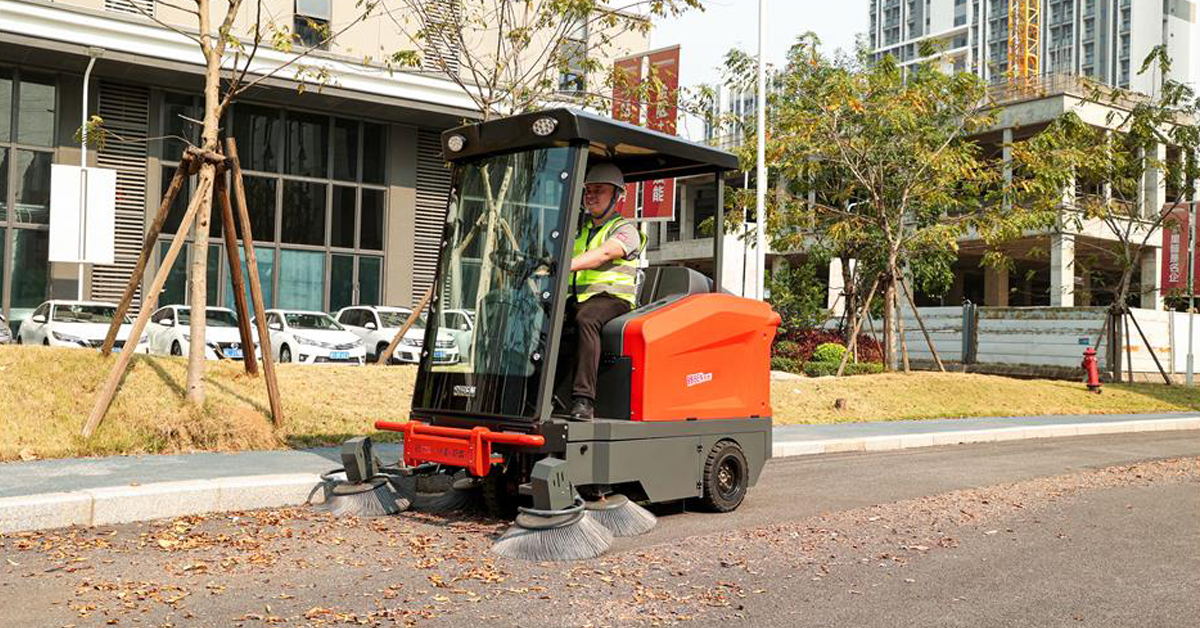
    • A: The walk-behind model can clean over 2,000 square meters per hour, while the ride-on model can clean over 16,000 square meters per hour. As the cleaning area increases, the labor savings significantly exceed 3–5 workers. Automated cleaning reduces management burdens and allows your employees to focus on more meaningful and value-added tasks.

  • Q: Can gravel, iron filings, and dust be swept clean in one pass? Will it cause secondary dust emissions?

    • A: Yes, it can clear them in one pass—even bricks can be swept up. The equipment features a professional atomized dust suppression system to ensure no secondary dust is generated.

  • Q: Are the clean water tank and waste hopper capacities large? Do I need to empty the trash frequently?

    • A: Both the water tank and the waste hopper have large capacities, typically requiring you to empty the trash only after cleaning about 20,000 square meters.
      6E3A7952.JPG

II. Battery and Maneuverability

  • Q: How long can the battery last on a full charge? Will I need to charge it halfway through the shift?

    • A: On a full charge, it can run continuously for 3–8 hours. We configure different battery options based on your specific requirements to resolve any range anxiety.

  • Q: Can it easily cross factory thresholds and small ramps? Will it get stuck?

    • A: We have specialized cleaning equipment for climbing. It can easily handle slopes of up to 40 degrees in underground garages, and thresholds of 3 cm are not a problem at all.

6E3A7804.JPG

III. Durability and Maintenance

  • Q: Is the machine body sturdy? Is it prone to damage from frequent collisions in the factory?

    • A: Our machines are "industrial-grade" and built to be rugged. They are equipped with an electronic parking brake; the machine stops immediately when the throttle is released to ensure safety. We prioritize robust industrial equipment; in one instance, a client's interns played "drifting" and hit a wall, damaging the wall, but the machine remained perfectly fine.

  • Q: What is the warranty period, and is the maintenance cost high?

    • A: The A-series comes with a 1-year warranty, and the S-series has a 2-year warranty. Consumables like brushes and filters cost only a few dozen yuan, offering a competitive advantage. Annual maintenance costs are around 500 yuan—barely over 1 yuan per day—which is cheaper than the cost of replacing traditional manual brooms.

IV. Value Comparison and Long-Term Investment

  • Q: Others with the same configuration are thousands cheaper; where does your higher price come from?

    • A: In the current market, no one wants to drive customers away. The price difference comes down to three factors:

      1. Materials: We use imported materials and sufficient, high-quality components. If we used cheaper or thinner materials, the effect might be the same initially, but the equipment lifespan would be much shorter. We want to build long-term relationships and earn a reputation that brings us referrals, rather than being "one-and-done." While others are thousands cheaper, our machines last about 8 years, while cheaper ones might last 3. Is it really cheaper in the end?

      2. Service & Support: We provide superior service, better configurations, and more effective cleaning results.

      3. Overall Quality: Our focus is on long-term value, not just short-term price competition.

NEWS
Warehouse & Workshop Dust Cleaning Compliance Guide: Eight Steps from System to Documentation
2026 / - 10 / - 09

This article outlines the compliance pathway for dust cleaning and management in industrial and trade enterprises, structured across eight key phases: cleaning systems and protocols (assigning responsibilities, target areas, frequency, and record-keeping), frequency and shift scheduling (zoned according to dust generation intensity), blind spots and high-level dust accumulation checklists, cleaning tool configuration (replacing compressed air purging with industrial vacuum cleaners and implementing wet floor scrubbing), secondary dust control and waste transfer, auxiliary inspection of dust removal systems, five categories of record-keeping logs, and compliance self-inspection checklists. Verified parameters of SIBEN's XC-series industrial vacuum cleaners and X-series floor scrubbers are integrated for equipment selection reference.

Lithium Battery Factory Floor Cleaning Solutions: Siben Industrial Sweepers & Scrubbers for Clean, Safe EV Production
2026 / - 09 / - 30

This article explains the unique floor-cleaning challenges of lithium battery production — conductive powder hazards, epoxy coating protection, and moisture/electrolyte control — and shows how a two-stage "sweep then scrub" workflow solves them. It details the Siben A300 (5580㎡/h), A600 (9500㎡/h) and A900 lithium-ion sweeper (16000-22000㎡/h, 5-6 hour runtime) together with X-series scrubbers, and provides selection guidance and an FAQ for facility and EHS managers.

How to Choose Cleaning Equipment for Auto Repair Workshops & 4S Stores: Start with 4 Contaminant Types & 5 Functional Zones
2026 / - 10 / - 06

This article proposes a "classify first, then zone" equipment selection framework for complex cleaning scenarios in auto repair workshops and 4S service centers. It first identifies four contaminant types (oil, dust, paint, mud) and their corresponding cleaning strategies, then provides equipment configuration recommendations for five functional zones — service bays & lifts, body & sanding stations, paint mixing & spray booths, car wash area, and customer reception & showroom. It also covers wet/dry separation principles, electrical & charging safety boundaries, consumables record-keeping, and six quantifiable procurement acceptance criteria, helping readers build a compliant, efficient and practical workshop cleaning system from scratch.

How to Procure and Inspect Industrial Cleaning Equipment: 6 Stages from Requirements to Final Acceptance
2026 / - 10 / - 07

This article treats industrial cleaning equipment procurement as a "mini-project," systematically breaking down six stages: requirements writing, technical parameter classification, supplier evaluation, three-level acceptance, hard contract clauses, and compliance documentation. The core approach is to translate "what to buy" into "what problem to solve," distinguish verifiable parameters from reference-only claims, evaluate suppliers through a scoring system, implement factory/delivery/final acceptance stages, and secure the deal with four contract clauses: payment tied to acceptance, warranty response, spare parts supply, and training. The article concludes with 10 FAQ and actionable checklists.

Commercial Cleaning Robot Deployment and Maintenance: A 7-Stage Guide from Site Conditions to Maintenance Ledger
2026 / - 10 / - 08

This article systematically breaks down seven stages of commercial cleaning robot deployment and long-term operation: confirming floor/traffic/network/management conditions before deployment; managing maps as versioned assets; defining physical, human-robot, and emergency safety boundaries; replacing consumables on cycle rather than on feel with proper battery management; grading faults into three levels with human-robot handoff rules; planning task allocation and resource queuing for multi-robot scenarios; and using six ledger types and four dashboard metrics for auditable maintenance management. The core thesis is that a cleaning robot is not a "black box" that runs itself once plugged in — long-term stable operation depends on whether deployment conditions are met, whether maps keep up with site changes, whether consumables are replaced on schedule, and how humans and machines hand off during faults. Includes 10 FAQ and a remote support CTA.

Industrial Cleaning Equipment Noise Control Technology: The Engineering Behind 60dB Quiet Cleaning
2026 / - 09 / - 29

This article breaks down the four core noise control technologies that enable Siben's industrial sweepers to achieve 60 dB(A) operation — equivalent to normal conversation. Through detailed engineering analysis of motor vibration isolation, brush system acoustics, airflow and filtration design, and chassis sound insulation, it explains how the A300 (2000W, 320kg) and A600 (3780W, 590kg) maintain identical 60dB noise levels despite vastly different power outputs. Real-world deployment cases in noise-sensitive environments like schools and commercial spaces demonstrate the practical value of low-noise industrial cleaning equipment.

Siben Manufacturing Craftsmanship: The Quality Assurance System Behind Industrial Cleaning Equipment
2026 / - 09 / - 28

This article reveals how Siben manufactures industrial cleaning equipment through rigorous engineering standards, an 8-stage quality control pipeline, and a comprehensive after-sales service network. It covers the Thunder God AMR autonomous cleaning robot, A-Series ride-on sweepers (A300/A600/A900), and X-Series floor scrubbers, helping procurement decision-makers understand why manufacturing quality directly impacts equipment lifespan, total cost of ownership, and cleaning performance.

Industrial Sweeper vs. Floor Scrubber: Which Machine Does Your Facility Actually Need?
2026 / - 09 / - 24

This article addresses the most common questions from factory purchasers regarding the choice between industrial sweepers and floor scrubbers. It covers the cleaning principles (dry sweeping vs. wet scrubbing), suitable application scenarios, a comparison of the specifications for the S-Pen A series sweepers (A300/A600/A900) and the X series floor scrubbers (X1-X8), and six frequently asked questions, along with a three-step decision-making process, to help users select the appropriate equipment based on the type of soil, cleaning requirements, and area size.