SIBEN Industrial Floor Scrubber: FAQ for Efficient Enterprise Cleaning Solutions

Views: 12     Author: SIBEN     Publish Time: 2026-07-01      Origin: Site

Inquire

facebook sharing button
twitter sharing button
line sharing button
wechat sharing button
linkedin sharing button
pinterest sharing button
whatsapp sharing button
sharethis sharing button

Thank you for your interest in SIBEN industrial cleaning equipment. As a professional manufacturer in the industrial floor cleaning sector, we understand that efficiency, durability, and comprehensive after-sales support are core considerations when choosing a partner. We have compiled the following detailed answers to your questions regarding scrubber performance, after-sales service, and usage costs:

  • Q1: Can it clean heavy oil stains in one pass without leaving water marks? A: Absolutely. We have equipped our machines with high-power vacuum motors specifically for heavy oil conditions, ensuring a one-pass clean with no water residue. Additionally, the equipment comes standard with oil-resistant squeegee blades that resist corrosion and deformation from oil.

  • Q2: How long does it take for after-sales service to arrive, and are there local repair centers? A: SIBEN has established comprehensive sales and service networks in the Yangtze River Delta and Pearl River Delta regions. In other areas, we follow a "proximity principle," assigning technicians from the nearest technical department to provide on-site support. Our response mechanism includes a 5-minute response time, a 30-minute solution proposal; technicians arrive on-site within 24 hours in first-tier cities and within 48 hours in second-tier cities and above. Furthermore, we offer free lifetime repairs (labor fees only).

  • Q3: Can the battery life meet the needs of continuous workshop cleaning for a full day without intermediate charging? A: Our equipment offers a single-charge runtime of 3-6 hours, depending on the battery configuration. This capacity is fully capable of meeting daily high-intensity, continuous cleaning requirements in workshops.
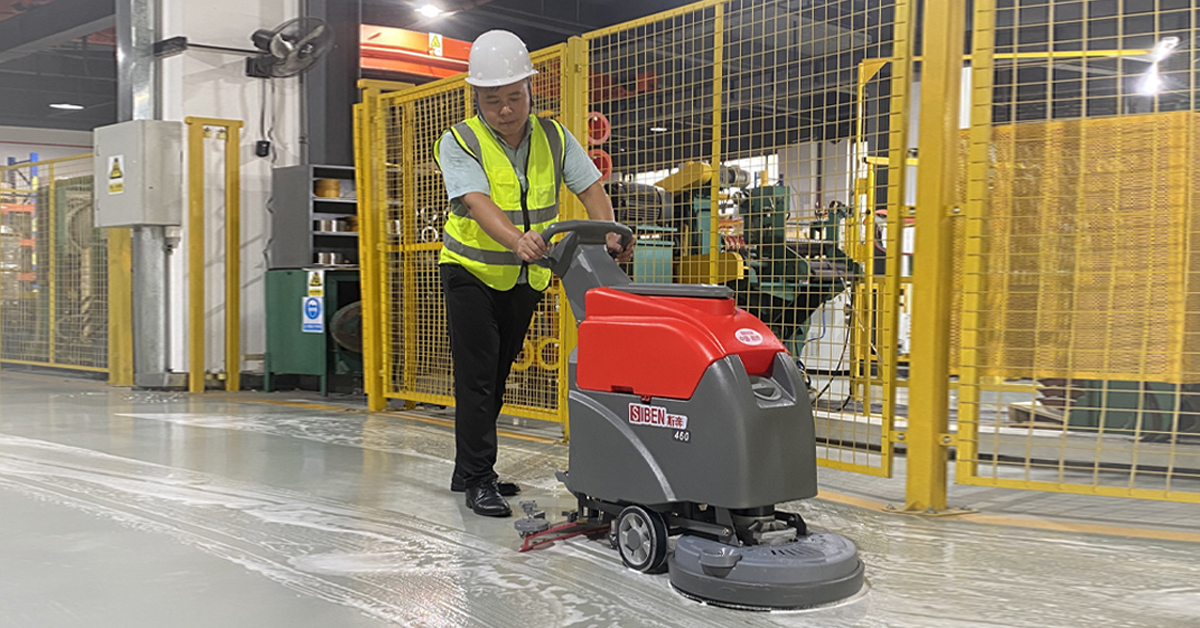
    Walk-Behind Floor Scrubber X2 (4).jpg

    (Click the image for more details)

  • Q4: How large are the clean and recovery water tanks, and can they reduce the frequency of water changes? A: Our large industrial scrubbers feature tank capacities of over 300 liters, allowing for a cleaning coverage of over 20,000 square meters on a single fill, significantly reducing downtime caused by frequent water changes.

  • Q5: Is the brush pressure sufficient, and is it suitable for epoxy and concrete floors? A: Our scrubbers feature a brush pressure of up to 50+ kg, providing powerful decontamination suitable for various floor types. We recommend the most appropriate model based on your specific floor material (such as epoxy or concrete) to ensure optimal cleaning results.

  • Q6: Are the annual costs for squeegees, brushes, and consumables high? A: We are committed to long-term partnerships and rely on our excellent reputation for customer referrals. Therefore, we offer a highly competitive "Annual Consumables Package" for just 400 RMB, which covers your basic consumable needs for the entire year, greatly reducing your maintenance costs.

  • Q7: Is the machine's failure rate high, and will downtime affect workshop production? A: Statistics show that our machines have an extremely low annual failure rate, with most issues being operational rather than mechanical. As long as the equipment is used in accordance with our training guidelines, it remains highly stable and will not impact your workshop's normal production.

  • Q8: What is the climbing ability like, and can it work normally on ramps in warehouses? A: We offer specialized models with strong climbing capabilities for scenarios involving ramps or underground parking structures, ensuring efficient and safe operation on inclines.

  • Q9: Is the noise level high, and will night shifts disturb employees? A: The equipment is electrically driven and operates smoothly. If you have strict noise requirements, we also provide specialized "Quiet Models" developed for schools and laboratories, which keep noise levels below 60 decibels, ensuring no disruption to rest during night shifts.
The above information is for your reference. If you have any specific needs regarding equipment selection or require more detailed technical specifications, please feel free to contact us via the SIBEN service hotline. We are dedicated to providing you with tailored cleaning solutions and look forward to building a deep, long-term partnership with your company.

Industrial Cleaning Robot Deployment Guide: Route Stability and Equipment Selection
2026 / - 08 / - 24

This guide provides a comprehensive framework for buyers evaluating industrial cleaning robots and equipment. It outlines essential site assessment criteria—such as route stability, obstacle handling, and infrastructure readiness—and details how to match SIBEN cleaning solutions (including Leishen GT and Fengshen) to specific facility workflows for optimal return on investment.

Industrial Cleaning Equipment: Rental vs. Purchase? A Complete Buyer's Decision Guide
2026 / - 08 / - 19

This article provides a scenario-specific decision-making guide for facility teams comparing the rental versus purchase of industrial cleaning equipment. The author emphasizes that decisions should not be based solely on monthly rent or purchase prices, but rather on the Total Cost of Ownership (TCO), including labor savings, maintenance responsibilities, downtime risks, and usage frequency. By evaluating actual operational workflows—such as cleaning areas, soil types, and working windows—businesses can select the optimal equipment strategy to maximize efficiency and control long-term costs.

How to Choose Low-Noise Industrial Cleaning Equipment for Malls, Hospitals, and Schools Based on Cleaning Conditions
2026 / - 08 / - 21

Addressing the noise-sensitive environments of shopping malls, hospitals, and schools, this article analyzes their unique working conditions, including customer traffic flows, 24/7 noise sensitivity, and class schedules. By comparing cleaning pain points across these venues, it offers targeted recommendations for low-noise industrial cleaning equipment: malls prioritize efficiency and Eco-silent modes; hospitals demand ultra-silent performance (56-60 dB) and antibacterial features; and schools balance indoor quietness with multi-surface adaptability. A core comparison table is included to guide facility managers and procurement teams in making informed, high-efficiency decisions.

Industrial Vacuum Selection and Cleaning Equipment Guide
2026 / - 08 / - 20

This guide outlines key considerations for selecting industrial vacuums and floor scrubbers based on dust types, particle sizes, and debris. It highlights the importance of using industrial vacuums as a pre-cleaning tool before wet scrubbing, introduces SIBEN’s automated and standard equipment matching solutions, and provides practical decision criteria to optimize long-term facility cleaning costs.

Guide to Industrial Cleaning Equipment Procurement and Manufacturer Evaluation
2026 / - 08 / - 18

This article explores key factors in industrial cleaning equipment procurement, highlighting that a manufacturer's service capabilities—such as after-sales maintenance, parts supply, and training—are just as critical as machine performance. It guides buyers on scientifically pairing scrubbers, sweepers, and cleaning robots based on workflow, floor materials, and traffic flow, while evaluating total cost, delivery, and support for long-term operational success.

Cleaning Equipment Selection for Electronics Manufacturing Areas
2026 / - 08 / - 17

This article explores the core logic and equipment selection methods for industrial floor cleaning. It points out that factory floor cleaning cannot be evaluated based on area alone; instead, different types of dirt—such as oil stains, dust, metal shavings, and tire marks—must be categorized and treated accordingly, alongside the implementation of a scientific workflow consisting of "sweeping/dust extraction first, followed by scrubbing." Meanwhile, combined with SIBEN's product line (such as walk-behind/ride-on floor scrubbers, industrial cleaning robots, sweepers, and industrial vacuum cleaners), the article provides buyers with decision-making criteria based on facility layout, aisle width, operating time, and long-term costs. It emphasizes the integration of machine combinations, practical operational workflows, and long-term after-sales support to achieve efficient cost reduction.

What Industrial Cleaning Scenarios Are High-Pressure Cleaners Suitable For? Surface, Floor, and Outdoor Stain Treatment
2026 / - 08 / - 14

This article briefly introduces the applications of high-pressure cleaners in the industrial sector, focusing on three core scenarios: Equipment Surface Cleaning: Efficiently removes oil stains and rust for precise maintenance. Floor Deep Cleaning: Quickly breaks up stubborn oil films to eliminate slip hazards. Outdoor Environmental Treatment: Easily handles large-scale stubborn stains and pipeline dredging, helping enterprises reduce costs, increase efficiency, and ensure safe production.

Airport & High-Speed Rail Station Cleaning Equipment Allocation Guide
2026 / - 08 / - 13

This article provides a comprehensive guide on scientific cleaning equipment configuration and zoning management for ultra-high-traffic transit hubs such as airports and high-speed rail stations. It highlights core challenges like complex flooring, non-stop passenger flow, and strict slip-resistance requirements, while offering tailored scrubber, sweeper, and vacuum selection strategies across various functional zones including indoor halls, passenger corridors, outdoor plazas, and parking lots. Additionally, it outlines key evaluation criteria such as noise control, water absorption, battery endurance, and unified procurement to help property managers achieve efficient, cost-effective floor care operations.